
A Capacitor can damage a bearing?
A beautiful motor failure
Now, let's make it clear from the start. It's not Matt, it's Joe here. The Technical Manager here at Fletcher Moorland. However, this is something we thought you'd find insightful.
Have you ever seen a faulty capacitor destroy a motor bearing? Until recently I certainly hadn’t!
But before I dive into this specific case, I should probably give some background on what bearing currents are. A bearing usually consists of an outer race, inner race and a number of rolling elements. Now these steel parts are insulated by a thin film of grease. If the voltage on the shaft of the motor rises higher than the dielectric strength of the grease, then a tiny discharge event occurs which is hot enough to make a small crater in the metal parts and to burn the grease. Over time this damage builds up and can cause premature failure of the bearing.
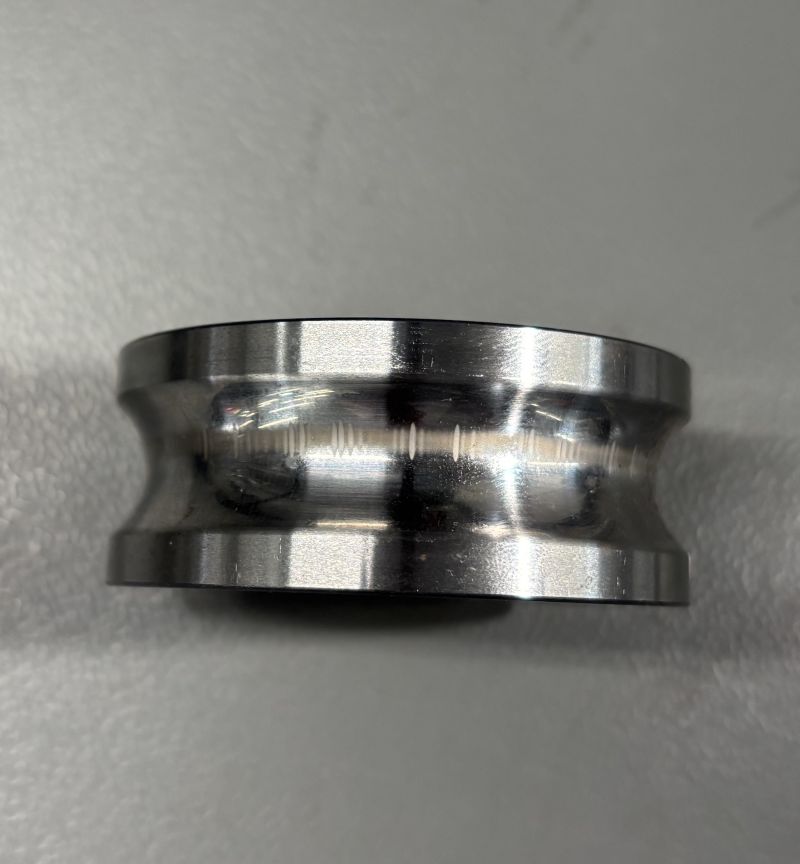
Now I know that it’s rare for a motor failure to be described as beautiful but in this case, it really is! The picture I have attached shows the fluting damage to the bearing race and is a classical (and very pretty) sign of bearing currents.
CONTACT US
One of our customers had been struggling with bearing currents on a particular motor for some time. I am not going to mention any names, but this customer is in the top tier when it comes to reliability and understanding bearing currents. They had performed some very good analysis and had still been unable to solve the problem. In an act of desperation, they had replaced the inverter for new and miraculously the bearing currents disappeared. They had not changed any parameters, and the replacement inverter was the exact same manufacturer and model. So what was going on?
After conducting a number of tests, I found that there were some very significant common mode currents on the output of the drive to the motor. This was not caused by the motor or cable system and so the inverter must be faulty in some way and causing the issue.
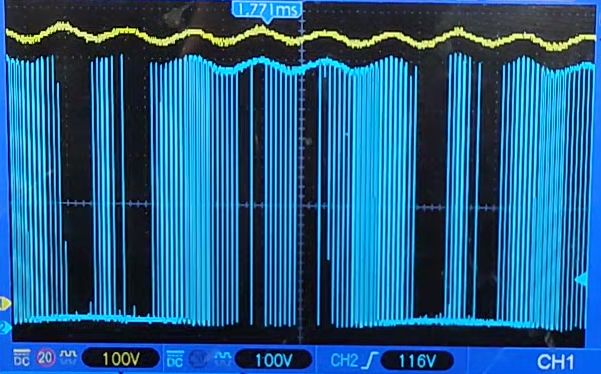
The picture of the oscilloscope waveforms show what I found: The yellow trace shows the DC bus of the inverter and the blue waveform shows the output voltage on one of the phases. As you can see the DC bus has a sinusoidal ripple with a peak to peak value of around 50V and a frequency of 300Hz. The 300Hz corresponds to full wave rectification of a 50Hz three phase supply but the ripple is much larger than it should be, especially at minimal load. A quick test of the bus capacitors showed that they had started to fail with a high equivalent series resistance.
So what can we take away from this little story?
Firstly a faulty inverter absolutely can cause the mechanical failure of a motor. I wonder how many mechanical failures of motors are incorrectly chalked up to mechanical issues when they were in fact caused by the inverter?
Secondly, servicing of inverters can stop these failures occurring, as long as they are carried out properly.
Contact Us
Please fill in the contact form to get in touch with us or contact us on the relevant channels below.
Fletcher Moorland Ltd.
Elenora Street
Stoke-on-Trent
Staffordshire,
ST4 1QG
Opening Hours:
Monday - Sunday: Open 24 hours


